
HEB profile
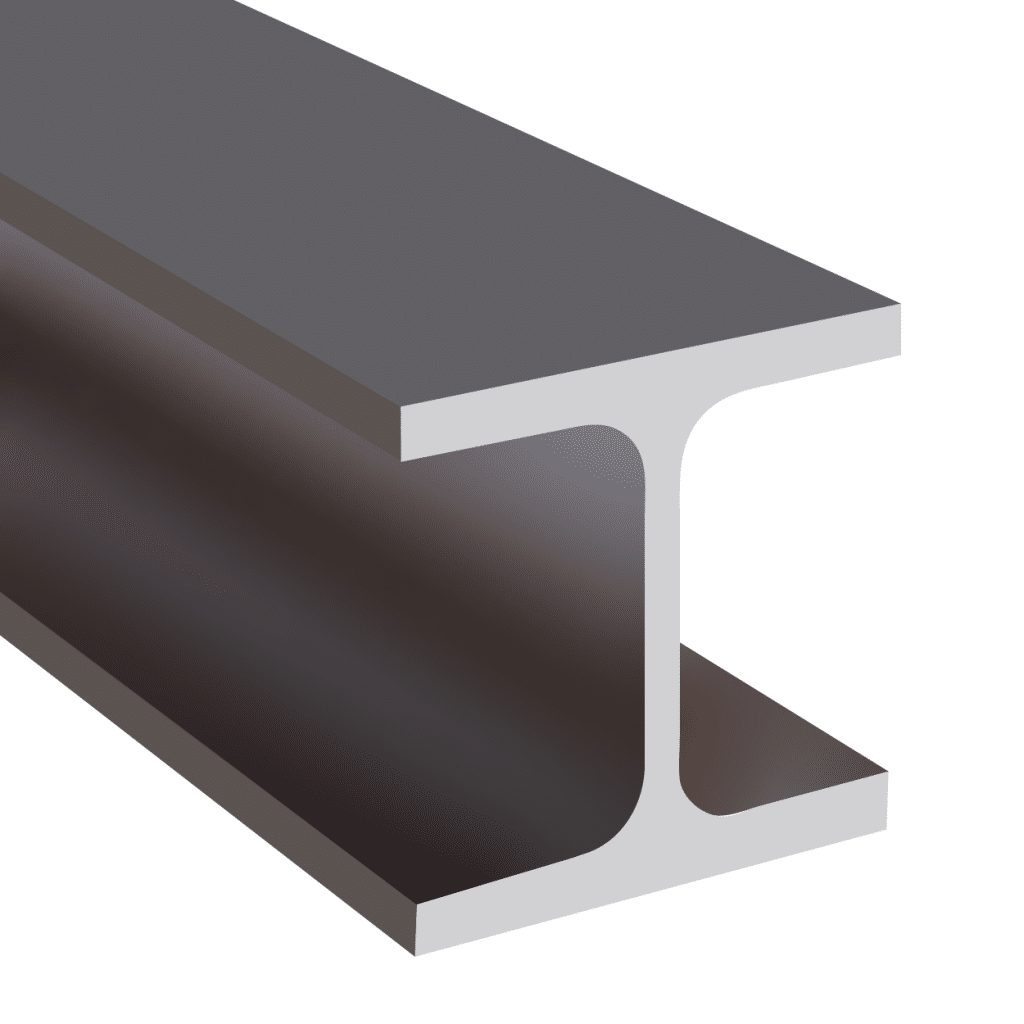
HEB beams are structural steel sections manufactured by hot rolling. Its application covers various sectors, such as industry, commerce and construction.
Their characteristics are stipulated by the UNE-EN 10025 standard, while the ASTM standard classifies them under the A36 designation. These sections, also known as wide-flange parallel-faced beams, have an H-shaped cross-section. Their flanges are perpendicular to the web, which ensures a constant thickness along the beam. Both the inner and outer faces are arranged parallel to each other.
These profiles are identified by the designation HEB followed by a number, which indicates their nominal overall height (h) in millimetres. There are several types, with series ranging from HEB 100 to HEB 900. The loads or weights they can support are directly related to their dimensions or measurements.

Measurements
HEB beams are available in various dimensions, including height, flanges and web, as well as in different grades, the most common being S275 JR and S355 J2.
These structural elements can be subjected to various surface treatments, such as shot blasting, painting and galvanising, to improve their durability and resistance to environmental elements. Standard lengths of HEB beams are typically 6, 12 and 15 metres, providing flexibility in their application in a variety of projects.
Your tailor-made project
Send us your ideas and in less than 24 hours you will get an answer about the budget of your project. We contribute to the development of final products that adapt to the spaces required by companies.

Application HEB profile
These HEB beams find frequent applications in the construction of various structures, notably in the construction of industrial buildings and other types of buildings. They are also used as structural elements in bridge construction and in the manufacture of machinery and other industrial equipment. Its versatility extends to specific functions such as:
- Lintels
- Leashes
- Pillars
- Structural reinforcements
- Porticos
- Ceilings
- Joists
- Supports
- Structures for staircases
In addition, in the context of metal structures, it is common to find anchor plates that are connected by welding or bolted to the bases of profiles, providing additional strength to the overall configuration of the structure.
Other types of profiles:



Save time, save money
With our services you outsource key processes of your business, making us your partner. We offer continuous communication throughout the process, agreed deadlines and emergency service.
Our services
Laser tube
from 12 to 500 mm- Laser cutting is a non-contact process that allows cutting and machining of tubes and profiles of different cross-sections from straight tube bars, dimensionally accurate and high quality cuts. In addition to making assemblies and supports.
Plasma cutting
high-definition
for large dimensions - Any bevel cut can be made, with extreme precision and at high speed, on all types of materials and thicknesses. Plasma cutting allows good finishes with high cutting quality.
Our free guide is now available!
Download our specialised guide and discover practical strategies for process optimisation in the manufacture of metal structures.
A wide range of techniques and tools to help you optimise your metal structures. From tips on how to select the best material to strategies for caring for it over time.