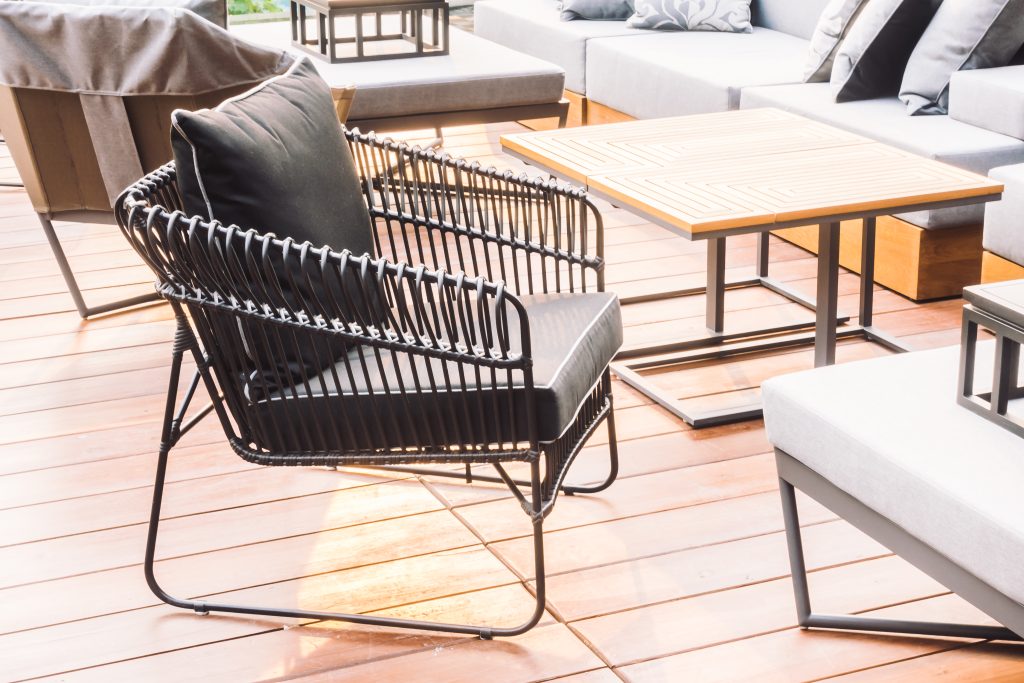
Have you ever wondered how outdoor furniture withstands the sun, rain and the passage of time? Behind each piece there is a design and manufacturing process that guarantees its durability. Both the choice of materials and the treatments applied to them are taken into account to create furniture that withstands the inclemency of the weather, without losing functionality or aesthetics.
That’s why Initube, with more than 40 years of experience in the tube and profile cutting and machining sector, explains the industrial processes that allow you to create high quality and resistant garden furniture. Are you ready to find out? Let’s go!
Durable and sustainable outdoor furniture materials
To ensure high quality outdoor furniture, it is necessary to employ a selection of strong and sustainable materials, each of which is carefully treated to maximise its lifespan and ensure its performance in adverse environmental conditions:
High-strength metals
The tubes and profiles manufactured include materials such as anodised aluminium and galvanised steel. While these metals are noted for being lightweight, they are also highly resistant to corrosion and wear, making them ideal for withstanding extreme weather conditions. In addition, anodising aluminium increases the strength of the material, making it less prone to deterioration over time.
Treated woods
In addition to materials such as aluminium, iron or stainless steel, woods such as teak and cedar undergo special treatments that make them resistant to moisture, insects and UV radiation, ensuring long-lasting durability without compromising their appearance.
Modern composites
Modern composites, such as fibreglass and certain recycled plastics, are another fundamental part of industrial outdoor furniture. These materials combine excellent mechanical strength with light weight, offering an excellent solution for structures requiring impact resistance and reduced maintenance.
Industrial manufacturing processes
Quality outdoor furniture depends not only on the materials used, but also on industrial manufacturing processes. In this sense, technology plays a fundamental role in ensuring the quality and strength of each manufactured piece:
Protective coatings
To increase the durability of outdoor furniture, processes such as powder coating and metal anodisation are used. Powder coating provides a uniform finish, and also protects against corrosion and the effects of continuous exposure to natural elements such as moisture and UV rays. Metal anodising, on the other hand, improves corrosion and wear resistance by creating a protective oxide layer on the surface of the material.
Welding and reinforcement assembly
Welding and assembly processes are also decisive for the structural stability of outdoor furniture. For example, high-precision welding techniques can be used to ensure a robust assembly, minimising weak points in the structures. In this way, products can be offered that are capable of bearing weight and resisting the elements for long periods.
Specific treatments against extreme conditions
For those customers whose installations are exposed to particularly adverse conditions, such as salinity in coastal environments or constant humidity, specific treatments are offered to improve the resistance of the products, such as anti-fungal treatments and special coatings that prevent rusting.
Resistance to weather and outdoor elements
Garden furniture must be able to withstand changing weather conditions and harsh environments. That is why we always seek to ensure that each of our products is subjected to rigorous endurance tests to guarantee its durability:
Endurance tests and certifications
Outdoor furniture is subjected to stringent tests, such as wind and sun resistance tests. These tests ensure that the products are able to maintain their functionality and appearance, even after prolonged exposure to the elements. Quality certifications are also in place to guarantee their performance under extreme conditions.
Innovations in UV and humidity resistance
Special coatings applied to garden furniture ensure greater resistance to UV rays, preventing the colour and texture of the furniture from deteriorating over time. In addition, the textile materials used for the cushions and accessories are treated to repel moisture and resist the formation of mould and mildew.
Extreme use cases
Solutions have also been developed for demanding applications, such as furniture in train stations or airports, where the demand for strength and durability is crucial. These spaces require furniture that can withstand intensive use, but also climatic aggressions.
Sustainability in industrial outdoor furniture design
Sustainability is a key aspect of outdoor furniture design, with a focus on minimising environmental impact through the use of sustainable materials and processes:
Recyclable materials
Aluminium and certain types of recycled plastics are used to manufacture products. These materials are 100% recyclable and allow a considerable reduction of the ecological footprint, contributing to the care of the environment.
Waste reduction in production processes
It is also important to consider the optimisation of production processes, as this is another way of contributing to sustainability. High-precision cutting and machining systems make it possible to reduce waste, thus making better use of raw materials.
Longevity as a sustainable approach
Garden furniture should be designed to have a long service life, thus reducing the need for frequent replacement and contributing to a more responsible consumption of resources.
Industry trends and new outdoor furniture technologies
The outdoor furniture industry is constantly evolving and Initube is committed to technological innovation to continue to lead the market:
Modular design
One of the latest trends in the industrial design of outdoor furniture is modular design. This technique allows furniture parts to be replaced individually, which facilitates repairs and helps to extend the life of the entire product.
New manufacturing techniques
The use of emerging technologies, such as 3D printing, is also being explored for the creation of customised components. In this way, faster and more flexible manufacturing can be realised, adapting to the specific needs of each customer without compromising on quality.
IoT technology integration
Although still at an early stage of adoption, the integration of sensors and IoT devices into outdoor furniture is being explored to improve the user experience. With this technology it is possible, for example, to monitor sun exposure or humidity, automatically adjusting some properties of the furniture to optimise its performance.
Customised industrial solutions
Durable and sustainable outdoor furniture requires a combination of high quality materials, advanced industrial processes and a constant focus on technological innovation. Initube, with more than 40 years of experience in the industry, is positioned as a benchmark in the manufacture of high quality outdoor furniture. Sustainability and technological innovation are part of our DNA, which allows us to offer solutions that adapt to the specific needs of each client.
If you would like to find out more about our tube and profile cutting and machining services or need a personalised consultation for your garden furniture project, please contact us. We are here to help you find the best industrial solution for your needs.