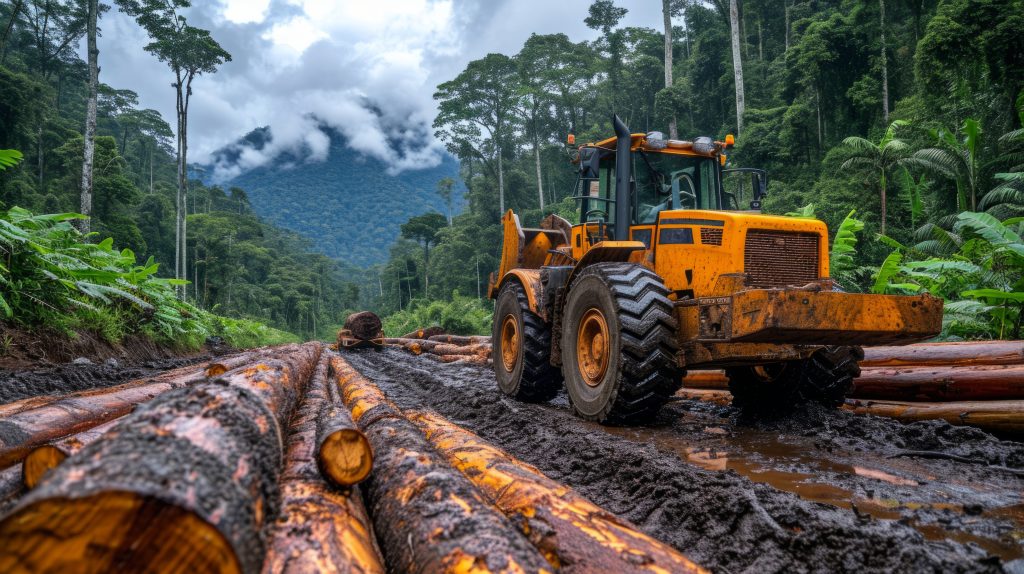
The European forestry sector turns over billions of euros each year and depends, to a large extent, on equipment that operates in extreme conditions: steep gradients, mud, continuous impacts and temperatures ranging from −20 °C in the Central European winter to the dry heat of the Mediterranean summer. That is why forestry machinery cannot afford mediocre components. And behind every harvester, skidder or processor lie hundreds of metres of metal tubes and profiles that must be cut, machined and assembled to the tightest tolerances.
Various analyses of the European forestry sector, including work related to the EFI, show greater mechanisation over recent decades, driven by the pursuit of greater efficiency and by pressure on labour costs.
For manufacturers and suppliers in this sector, that translates into growing demand for high-strength industrial tubular components. At Initube, we explain the key points of forestry machinery.
Types of forestry machinery that require tubular components
When we talk about forestry equipment, the variety is greater than it appears from the outside. Each type of machine has specific structural needs, and in all of them metal tubes and profiles are critical components:
Forestry harvesters (harvesters)
These are the most complex machines in the sector. Their cutting head, crane arm and main chassis incorporate high-strength structural steel profiles — typically S355 or S690 — which absorb continuous loading and unloading cycles. A harvester works for thousands of hours without stopping; any failure in the welded joint of a tube has a direct impact on production.
Skidders and forwarders
These log-skidding and transport vehicles work on uneven terrain with loads of several tonnes. Their articulated frames use thick-walled rectangular and square profiles, particularly at pivot points, where structural fatigue is greatest.
Processors and chippers
The metal parts for forestry equipment used in processing — cutting, debarking, chipping — require precision tubes for the hydraulic systems and feed arms. Here, the dimensional accuracy of the cut is decisive: a tube outside tolerance can compromise the alignment of the hydraulic cylinders.
Industrial brush cutters and forestry tractors
Although of smaller tonnage, these machines use tubular profiles in their ROPS (Roll-Over Protective Structure) and FOPS (Falling Object Protective Structure) protective structures, regulated by European legislation. The tube in these systems must not only have the correct strength: it must be cut to the exact geometry to meet the homologation requirements.
Technical requirements for tubes and profiles in forestry equipment
Forestry work subjects metal components to a combination of stresses that is difficult to replicate in a laboratory. The constant vibrations caused by uneven terrain generate fatigue in the welded joints. Moisture — rain, fog, mud — accelerates surface corrosion if the material is not properly specified or protected. And localised impacts, frequent when handling logs, demand materials with high impact toughness.
That is why product engineers in the sector typically specify standardised structural steels such as S355J2 for standard applications, and S690QL for components subjected to greater mechanical stress. For parts exposed to particularly corrosive environments or to plant protection products, stainless steel AISI 304 or 316L is used.
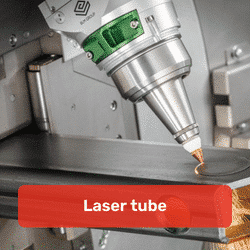
As for the manufacturing process, cutting tolerances are key. A tube for a hydraulic arm cannot show burrs on the cut or angular deviations that hinder subsequent assembly. Laser cutting offers higher dimensional precision than plasma cutting, with finishes that remove the need for additional cleaning operations. For complex geometries or threading, CNC machining complements the process with the same zero-tolerance-for-error philosophy.
Why precision cutting makes the difference in forestry machinery
A manufacturer of forestry machinery that outsources the cutting and machining of its tubular components to a specialist supplier gains not only in dimensional quality: it gains assembly speed, reduces material waste and obtains traceability for every part supplied.
When cutting is imprecise, the assembly operator compensates with time: adjustments, rework, corrective welding. That accumulated time, multiplied across runs of 50 or 500 parts, represents a real cost that is rarely attributed to the tube supplier, but that originates there.
In forestry machinery, where robustness, reliability and assembly speed matter, working with tubular components cut and machined with precision allows references to be standardised, rework to be reduced and production to be accelerated. In fact, market analyses on forestry machinery point to sustained growth in the sector through to 2035, driven by mechanisation and automation, which reinforces the need for more repeatable and efficient processes across the entire supply chain. In that context, cutting precision ceases to be a workshop detail and becomes a measurable competitive advantage.
Biomass, renewable energy and agricultural machinery: sectors where tubes also take centre stage
The boundary between forestry machinery and other adjacent sectors is becoming increasingly blurred. Industrial chippers and pelletisers — machines used in forestry biomass management for renewable energy production — share the same structural requirements as traditional forestry equipment: high-strength tubular chassis, hydraulic feed arms and discharge systems with precision profiles.
The same applies to dual-purpose agricultural–forestry tractors, demand for which has grown in operations where forest management is part of the production cycle.
Forestry mechanisation and the energy transition go hand in hand: more biomass managed means more equipment in the field, more components manufactured and greater technical demands on each part. For suppliers in the sector, this represents a growth opportunity that, in turn, requires alliances with component manufacturers able to scale up without compromising quality.
How Initube works with forestry machinery manufacturers
The collaboration process with Initube is designed to fit into the workflow of industrial manufacturers, regardless of order size. Everything starts with sending technical drawings or DXF files: our team reviews the geometry, the specified materials and the required tolerances, and returns a detailed quote in the shortest possible time.
Once approved, production is carried out with laser or plasma cutting depending on the material and thickness, followed by CNC machining when the part requires it. Every batch undergoes dimensional control before leaving the factory to ensure that every tube or profile fully meets the customer’s specifications.
For manufacturers of forestry machinery working with short runs or prototypes, the absence of minimum order quantities is a differentiating factor: it allows geometries to be tested, designs to be adjusted and components to be validated without committing stock or resources.
Frequently asked questions about tubes and profiles for forestry machinery
Which materials are used in the manufacture of tubes for forestry machinery?
The most common are structural steel S355J2 for standard applications and S690QL for highly mechanically loaded components. In environments with intense moisture or chemical exposure, stainless steel AISI 304 or 316L is specified. The choice of material depends on the function of the part, the expected loads and the environmental working conditions.
What is the difference between laser cutting and plasma cutting for forestry parts?
Laser cutting offers greater dimensional precision, a better surface finish and a smaller heat-affected zone (HAZ), which is especially relevant for high-strength steels such as S690. Plasma cutting is more economical on thicker materials where the permissible tolerance is wider. For most structural components of forestry machinery, laser cutting is the recommended option when working with thicknesses up to 20–25 mm.
Can Initube supply custom components for small-run equipment or prototypes?
Yes. At Initube we work with no minimum order quantities, supplying anything from a single part for prototype validation to runs of several hundred units. The process is the same in every case: drawing review, quote, production and quality control before dispatch.
Components that don’t fail
Forestry operations do not allow for downtime. Every hour of machine standstill in the field has a direct cost, and in most cases that cost originates in a component that was not up to the demands of the environment.
At Initube we have over 40 years of experience in the sector, having worked with manufacturers of heavy machinery, agricultural equipment and structural components throughout Spain and Europe, supplying everything from unique prototype parts to continuous production runs.
Our facilities feature state-of-the-art laser and plasma cutting technology, CNC machining capability and a technical team that reviews every order before it leaves the factory.
If you are developing or manufacturing forestry machinery and need a supplier of tubular components that understands the demands of the sector, we are ready to help you. Contact our team and request your quote.